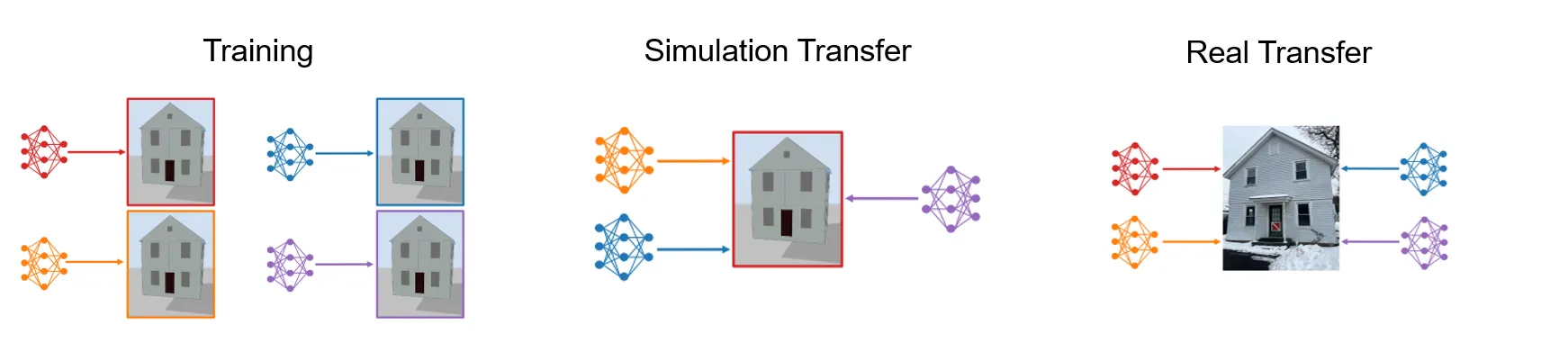
We need our building to operate with energy efficiency, thermal comfort, and resilience in mind. This is the aim of developing intelligent building controls to imbue buildings with the capability to autonomously maintain our buildings. The prevailing approach to deliver intelligent buildings has been model predictive control, which has been demonstrated in the research literature and through implementation by several start-up companies to work well in practice. However, this approach has a high initial start-up cost due to the development of an intelligent model, and during operation, it has high computational overhead and connectivity requirements. Reinforcement learning has been explored as an alternative approach that can reduce these high burdens during operation. However, this approach also has a high initial start-up cost due to the need to either secure high time resolution data or the development of a simulation environment to train the initial reinforcement learning agent.
Our work focuses on the latter due to high time resolution data about building operations, such as temperature, pressures, and flows, are often not available for many buildings. We are working to understand how to develop simulation environments that enable the development of reinforcement learning agents with “good” performance. Our aim is to understand how precisely these simulation environments need to be characterized, considering both building dynamics and parameter specification, to lead to good control performance. We are developing and evaluating these environments using building physics models of varying fidelities (using less complex models to control more complex ones) and in real-world tests in the BERL test facility. This project is ongoing.