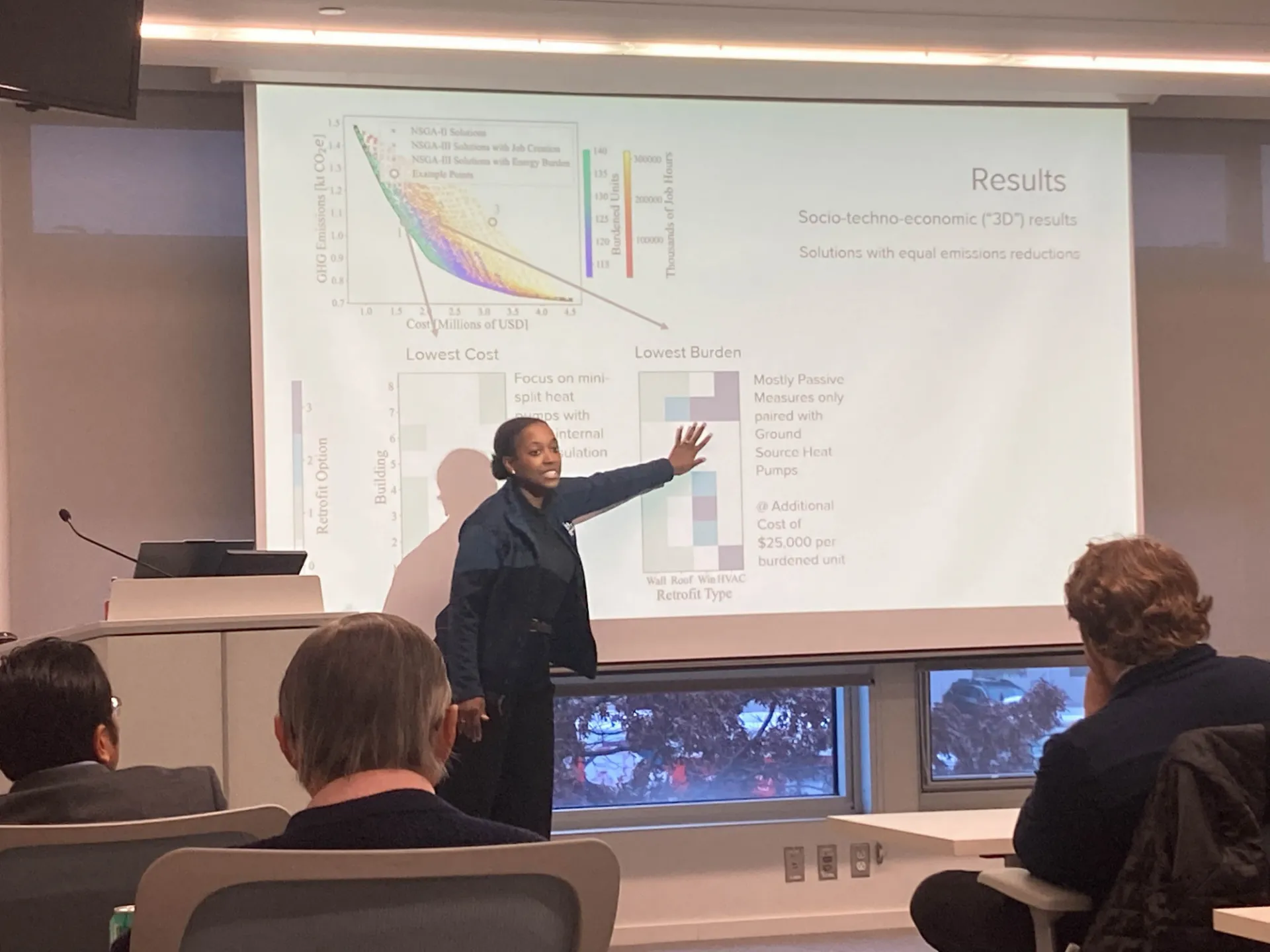
At the recent SyracuseCoE Research & Technology Forum, Dr. Bianca Howard, Assistant Professor of Mechanical Engineering at Columbia University, presented new research from the Building Energy Research Laboratory that examined how building physics, optimization, and artificial intelligence can support practical decarbonization strategies. Her talk highlighted work taking place at both the urban and building scale, showing how improved modeling and smarter controls can help cities and building owners reduce emissions while addressing real constraints on the ground.
Dr. Howard began by discussing her team’s work in West Harlem, where they used multi-objective optimization to compare retrofit strategies aimed at minimizing cost and emissions with strategies that also incorporated social goals such as reducing energy burden and supporting local job creation. She explained that once these additional objectives were included, the resulting retrofit portfolios shifted in meaningful ways, underscoring the importance of decision-support tools that reveal tradeoffs rather than hiding them.
She then turned to the building scale, where her lab has been studying how accurate a simulator must be to train reinforcement learning agents for HVAC control. Her team trained controllers on several EnergyPlus models with different thermal characteristics and found that even imprecise models produced agents capable of strong real-world performance. Dr. Howard noted that this finding could significantly reduce barriers to implementing intelligent controls because it suggests that reliable agents may be developed after a simple site visit rather than weeks of historical data collection.
Across both threads of research, Dr. Howard showed how physics-based insights, careful optimization, and AI methods can work together to create decarbonization strategies that are not only technically sound but also feasible and responsive to community needs.